
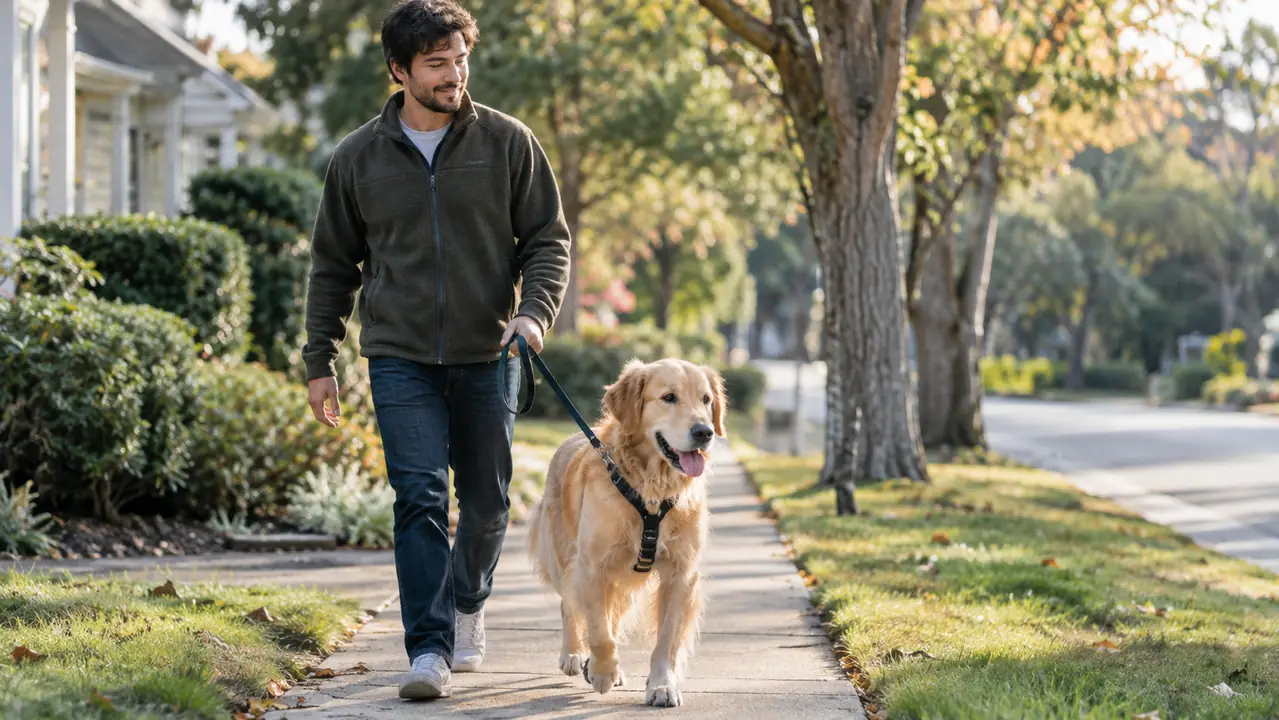
The first time I clipped the PetSafe Easy Walk Harness onto Bailey, my 45-pound mixed-breed rescue, she stopped dead on the porch and looked at me like I had betrayed her. The harness goes over the head, the chest strap crosses under the belly, and the leash clips at the chest instead of the back. That first walk was a disaster. She planted her feet, refused to move, and I spent ten minutes crouched on the sidewalk trying to figure out whether the front strap was too loose or too tight. Five months later, it is the harness we reach for on every single walk, but the honest version of this review is that the Easy Walk has quirks nobody puts in the product listing.
The Quick Verdict
A genuinely effective no-pull harness with a steep learning curve, a fussy fit, and a front clip that works best when you pair it with a short training period. Buy it for the steering, not for the convenience.
Amazon Check Today's Price →If your dog drags you down the block, this is the harness that gives you control back
The front clip changes the physics of pulling. It is not a magic fix, and you do have to learn how to fit it, but for a strong puller like my Bailey it made walks manageable in about a week.
Amazon Check Today's Price on Amazon →How I've Used It
Bailey is six years old, around 45 pounds, and came to us two years ago with zero leash manners. She was a stray before she was a rescue, and she had never learned that pulling on a leash does not get her where she wants to go. Before the Easy Walk, I used a back clip harness that gave me no steering at all. She would see a squirrel across the street, lunge, and I would brace myself like I was water skiing. My shoulders ached after every walk. My neighbor watched me get dragged past her mailbox one morning and very kindly suggested I look into a front clip.
I ordered the Easy Walk from PetSafe because it was the front clip harness our vet techs recommended most often at the clinic where I used to work. It came in a medium, which the sizing chart said fit dogs 25 to 50 pounds with a chest girth of 19 to 24 inches. Bailey measured right at 21 inches. The packaging was simple, no instructions booklet to speak of, just a diagram on the back of the card showing the three straps and which order they go on. That diagram is the entire story of why some people love this harness and some people hate it.
For the first three days, I put the harness on wrong every single time. The chest strap ended up too far back, the belly strap twisted, and the leash attachment point at the chest pointed sideways instead of straight. When I finally slowed down and followed the diagram step by step, the whole thing clicked. The martingale loop at the chest needs to sit right where the dog's neck meets the chest, not lower. The belly strap should be snug enough that you can slide two fingers under it. And the leash clip should face forward, not up. Get those three things right and the harness works exactly as advertised.
After five months of daily use, I can say the no-pull effect is real but it is not instant. The front clip does not physically stop a determined dog from pulling. What it does is redirect the pressure so that when Bailey pulls, her front end turns toward me instead of toward whatever she is chasing. That turning motion breaks the pulling cycle long enough for me to get her attention back. It took about a week of consistent use before she started to understand that pulling just made her walk in circles. Now, most days, she walks on a loose leash without me having to say a word.
What I Liked
- Front clip genuinely steers a pulling dog; walks got manageable in about a week
- Lighter and easier to clean than padded harnesses I tried
- Reflective stitching helps on early morning walks
- No pressure on the neck or muzzle, good for dogs sensitive around the face
Where It Falls Short
- Fit is fussy; the martingale loop and belly strap need regular checking
- Neck opening runs snug on dogs with broad heads
- Thin chest strap may wear faster on constant hard pullers
- Adjustment period is real; some dogs stop, roll, or paw at it at first
What Nobody Tells You About the Fit
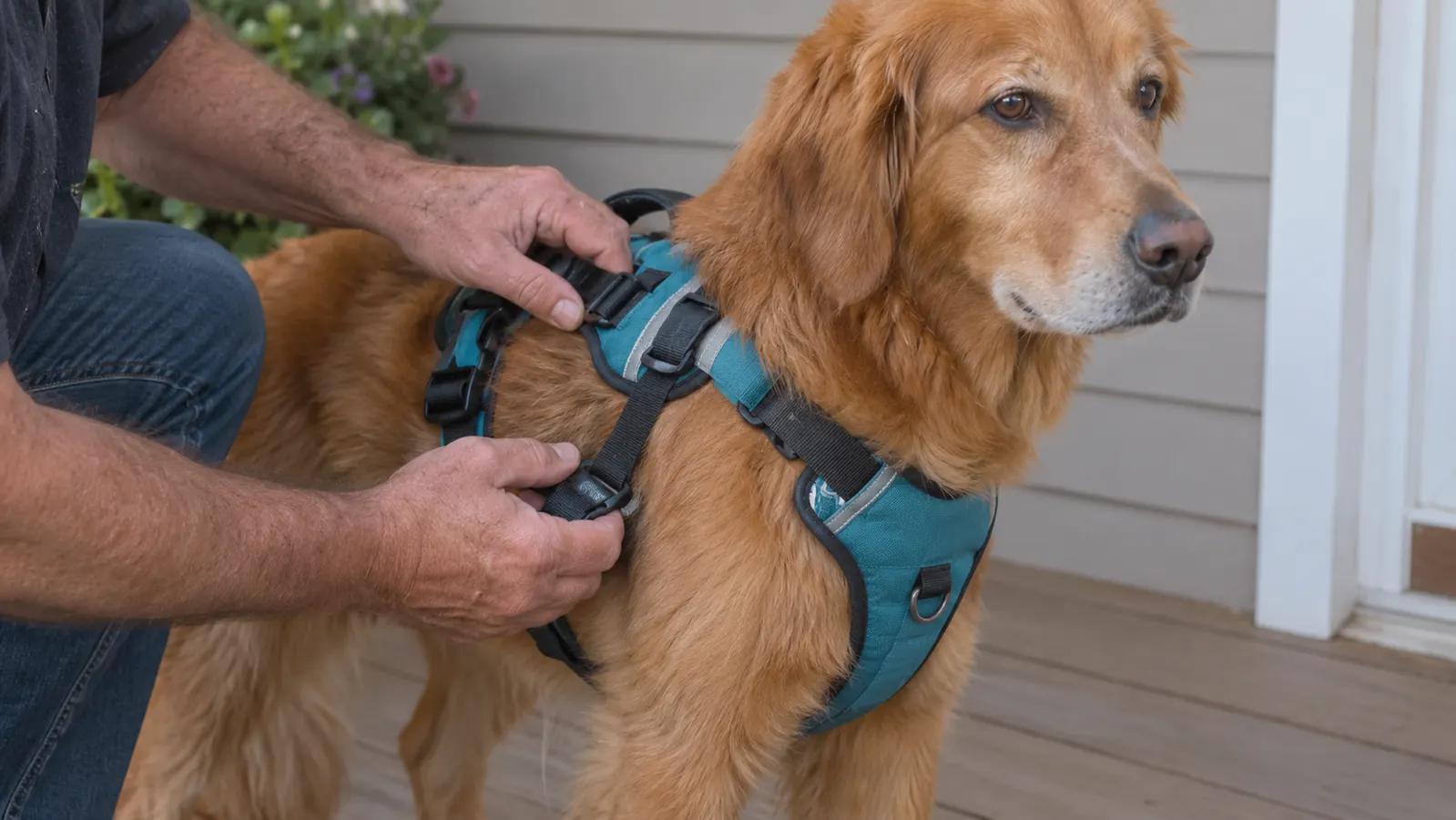
The single biggest thing I wish I had known before buying the Easy Walk is that the sizing chart is not the whole story. The medium fits Bailey's chest girth, but the neck opening is snug, and getting it over her head requires a bit of squishing. She has a broad head for her size, and the first few weeks she would pull back every time she saw the harness come out of the drawer. I learned to clip the leash on before I put the harness on, which gave me something to hold while I guided her head through. That sounds silly, but it genuinely solved the daily struggle.
The other fit issue is the belly strap. The Easy Walk uses a strap that buckles around the dog's middle, and it has a tendency to slide forward if it is not tight enough. If it slides too far forward, it can rub against the back of the front legs. I noticed a little hair loss on Bailey's armpit area during the second month, and that was my sign that the belly strap was sitting in the wrong spot. I tightened it by one hole, made sure it sat right behind her ribs, and the rubbing stopped within a week. This is a harness you have to check and adjust every few weeks, not a set it and forget it product.
The martingale loop at the chest also deserves a warning. It is a nylon loop that tightens slightly when the dog pulls, which is what gives the harness its steering power. But if you leave the leash attachment ring threaded through the loop in the wrong direction, the loop does not tighten at all. The leash ring needs to be threaded under and through the loop so that pressure pulls the loop closed. When I first used it, the ring was sitting on top of the loop, and the harness just slid around her body without doing anything. Flipping the ring to the correct side was the difference between a harness that worked and a harness that was just a pretty collar.
The Front Clip: How It Actually Works
The front clip is the whole point of the Easy Walk, and it works by changing the point of leverage. When a leash is attached at the back, a pulling dog is pulling against the strongest part of their body, their chest and shoulders. When the leash is attached at the chest, the pressure turns the dog's front end sideways the moment they pull. It is not a correction, it is a gentle steering mechanism, and it works best when you pair it with a cue like a treat or a happy voice to bring their attention back to you.
For Bailey, the front clip turned her lunging problem into a manageable quirk. She still gets excited when she sees a deer or another dog, and she still tries to pull, but the harness turns her toward me within a step or two. That gives me a window to redirect her before she gets fully worked up. I have also used the front clip on Pepper, my indoor cat, when I take her outside on a leash for supervised porch time. The Easy Walk is too big for her, and I would not recommend buying it for a cat, but the physics of a front clip are the same for any animal that pulls.
What I have learned is that the front clip is not a substitute for training. It is a tool that makes training easier. If you clip the leash to the front and then just let the dog pull, the harness will turn them in circles, but they may not learn anything. The magic happens when you pair the steering with a reward for walking next to you. I started by rewarding Bailey every time she looked back at me after the harness turned her. Within a month, she was checking in with me on her own, and the harness became less about correction and more about communication.
The front clip does not stop the pull. It turns the pull into a circle, and that circle is your chance to teach. That distinction is the whole honest review.
What Holds Up and What Does Not
After five months of daily walks, rain, mud, and one very enthusiastic roll in a pile of leaves, the Easy Walk is still in good shape. The nylon webbing has not frayed, the buckles still click securely, and the stitching on the martingale loop has held up fine. The plastic hardware is not the beefiest I have seen, but it has not cracked or warped. I would guess this harness has a solid year or two of daily use in it before the webbing starts to show real wear, and for what it costs, that is a fair deal.
The one weak point is the chest strap where it crosses the dog's sternum. It is a thin piece of webbing, and on a strong puller it bears a lot of pressure. Bailey has not managed to break it, but I can see where the webbing has started to flatten and soften. If you have a dog that pulls hard every single day, I would budget for a replacement harness at some point in the second year. That is not a deal breaker, but it is the kind of thing the product photos do not show you.
The reflective stitching on the chest strap is a nice touch. It catches headlights on our early morning walks, and it gives me a little extra peace of mind when we are out before the sun comes up. The stitching is still bright and intact after five months, which is better than I can say for some reflective gear I have owned. The martingale loop, though, is the part I have to monitor. It is designed to tighten, and it does, but if the webbing ever gets twisted it will not release smoothly. I check it every time I put the harness on, and I untwist it when I need to.

The Two-Week Adjustment Period
I want to be honest about the adjustment period because it is the number one reason people give up on this harness. The Easy Walk puts pressure in places a dog has never felt pressure before. The chest strap sits across the sternum, the belly strap goes under the middle, and the martingale loop touches the top of the neck. For a dog that is used to a back clip harness, this feels weird, and some dogs will stop walking, roll on the ground, or try to paw the harness off.
Bailey did all three in the first week. She planted her feet, she rolled on her back in the grass, and she tried to hook the chest strap with her front paw. I almost returned it. What kept me going was a trick I learned at the clinic: put the harness on the dog inside the house for ten minutes at a time, give them treats, and let them wear it while they eat dinner. By day four, Bailey stopped trying to get it off. By day seven, she was walking with it without drama. By day ten, she would come to me when I held the harness up, because she had figured out that the harness meant a walk.
If your dog is older, arthritic, or very sensitive to touch, the adjustment period may be longer. I would recommend introducing the Easy Walk slowly, in short sessions, and always pairing it with something positive. Do not just clip it on and head out the door on day one. That is how dogs learn to hate a harness, and once they hate it, it is very hard to get them to wear it willingly.
Who This Is For
The PetSafe Easy Walk Harness is for owners of medium to large dogs who pull on the leash and who are willing to spend a week teaching their dog what the front clip means. It is for people who walk their dog daily, who are tired of being dragged, and who want a tool that gives them mechanical advantage without being painful or harsh. It is especially good for strong dogs like Bailey, where a back clip harness is nothing more than a handle for the dog to pull against.
It is also a good fit for owners who have tried a head collar and hated it. The Easy Walk does not go near the muzzle, it does not jerk the head, and it does not put pressure on the neck. For dogs that are reactive to things near their face, a front clip harness is a much more comfortable option. And if you are a person with shoulder or back problems, the steering advantage of the front clip can genuinely reduce the strain on your body. I noticed the difference in my own shoulders within two weeks.
Who Should Skip It
If you are not willing to spend time on the fit and the adjustment period, skip the Easy Walk. It is not a product you can take out of the box, clip on, and expect instant results. The learning curve is real, and a dog that is determined to pull can still pull, especially if the harness is fitted wrong. If you want something that is genuinely easier to put on, a back clip harness with a step in design will win every time, but you will give up the steering.
Very small dogs may find the chest strap too bulky, and dogs with very deep chests or very narrow chests may have trouble getting a good fit. The sizing chart covers a range, but it does not cover every body shape. I would also skip the Easy Walk if your dog is a heavy, continuous puller like a sled dog type. The front clip will turn them, but the pressure on the thin chest strap will wear out faster, and a well-fitted back clip harness with a wide chest plate may be more durable for that kind of pulling.
Alternatives I Considered
Before I settled on the Easy Walk, I tried a back clip harness with a handle on the top. The handle was great for lifting Bailey into the car, but the harness did nothing for pulling. I also looked at a head collar, but Bailey hates anything near her face, and I did not want to fight that battle. I considered a gentle leader style collar, but I was worried about neck strain on a dog that lunges. The front clip harness was the option that gave me steering without touching her face, and the Easy Walk was the one our vet techs recommended most often.
I have also tried a couple of the newer front clip harnesses that use a padded chest plate instead of a thin strap. The padding is more comfortable for the dog, but the harnesses I tried were bulkier and harder to adjust. The Easy Walk is lighter, simpler, and easier to clean, which matters when your dog rolls in something unidentifiable at the dump. I rinse it under the hose, hang it on the porch rail, and it is dry by the next walk.
Give your shoulders a break and let the front clip do the steering
The Easy Walk is not a magic fix, but it is the most effective no-pull harness I have used on a strong, determined 45-pound rescue. If you are willing to learn the fit, it will change your walks.
Amazon Check Today's Price on Amazon →