
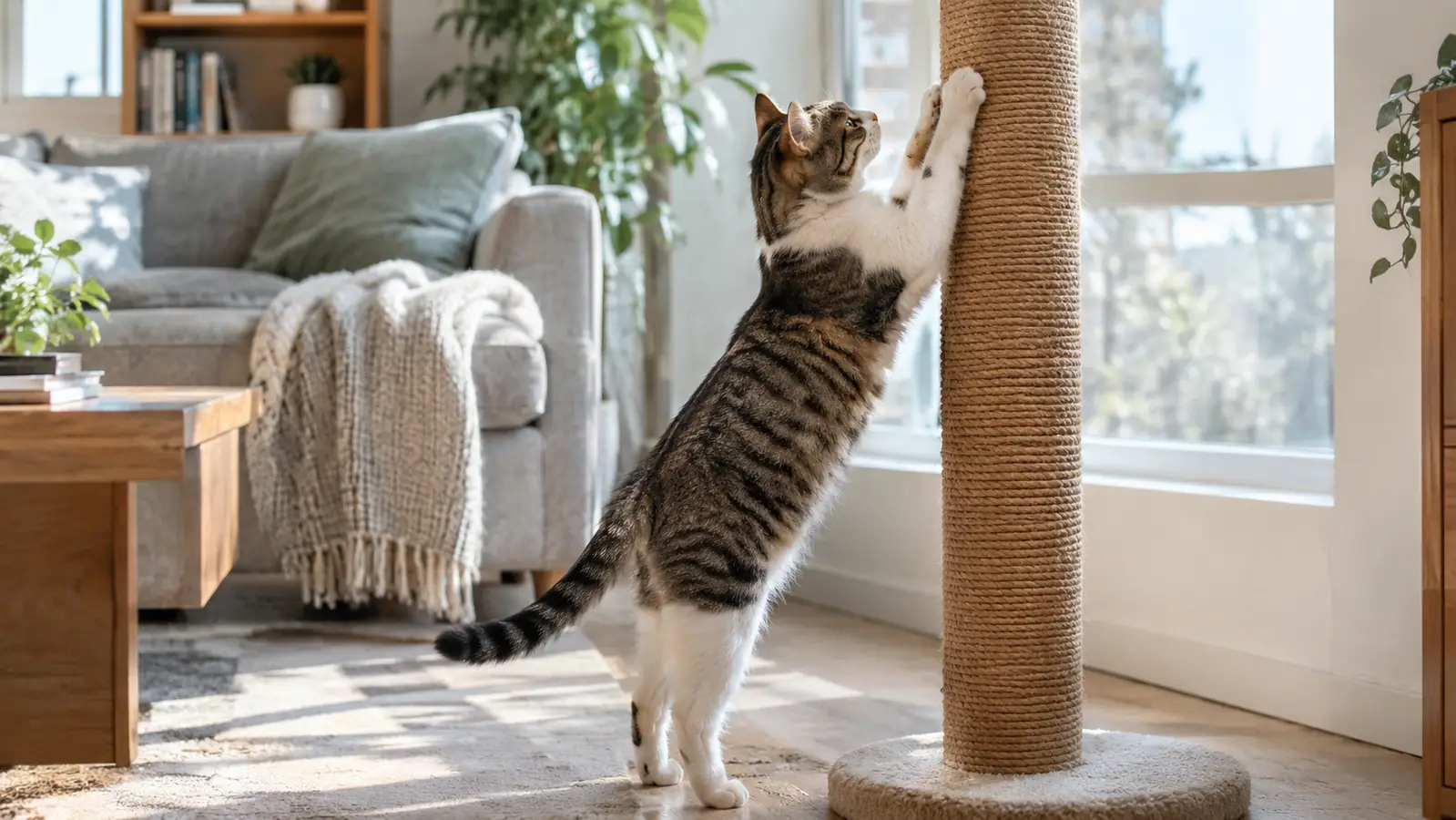
Every evening around eight, Pepper gets the itch. She walks past her food bowl, past the window, and plants her front paws on the arm of the couch. One claw out, a quick tug, and the fabric starts to run. That was the routine last spring, right up until the day I brought home the SmartCat scratching post and set it three feet from the spot she kept attacking.
I worked at a veterinary clinic for eleven years, so I know how cats think about scratching. You do not punish a cat for it. You redirect. You give them something better to scratch, in the place they already want to scratch, and you make it tall enough that they can really stretch. The SmartCat post checks all three boxes. I bought it with my own money, nobody asked me to write about it, and six months later the couch still has the one small mark from before, and nothing new. That is the review in one sentence.
The Quick Verdict
The tallest, simplest post we tried, and the only one Pepper uses every single day. Six months in, the sisal is intact and the couch is untouched.
Amazon Check Today's Price →The tall post that finally beat the couch
Pepper stretched, scratched, and left the furniture alone for six straight months. If your cat is a vertical scratcher, this is the one to try first.
Amazon Check Today's Price on Amazon →How I've Used It
I set the post up on a Thursday. The base is wide and the whole thing is heavy enough that I did not worry about tipping. I put it on the floor next to the armchair Pepper had claimed, which is also the spot where she greets me when I get home. She sniffed it, circled it, and within an hour she was on her hind legs raking the top third of the sisal. I had expected a week of coaxing with catnip. I got none.
The first month I kept a close eye on wear. The sisal sheds a little at the start, and for a few weeks I swept up short brown fibers. That is normal with natural sisal, and it stopped once the loose strands worked their way out. What surprised me was how often Pepper uses it. Not just the after-dinner ritual. She uses it when she wakes up, when she wants attention, and sometimes in the middle of the night. I hear the little thump of her landing, then the scritch-scritch from the other room.
Bailey, my six-year-old rescue dog, mostly ignores it. Once, early on, he leaned against the post and the whole thing did not budge, which told me the base was doing its job. He has knocked over every cardboard scratcher we ever bought. He has not knocked this one over once.
One thing I want to say about the catnip question. A lot of scratching posts need a sprinkle of catnip to get a cat interested, and that is fine. This one did not. Pepper found it on her own within the hour. I still put a little catnip on the base sometimes as a treat, but the post is not dependent on it.
Why a Tall Scratching Post Works Better
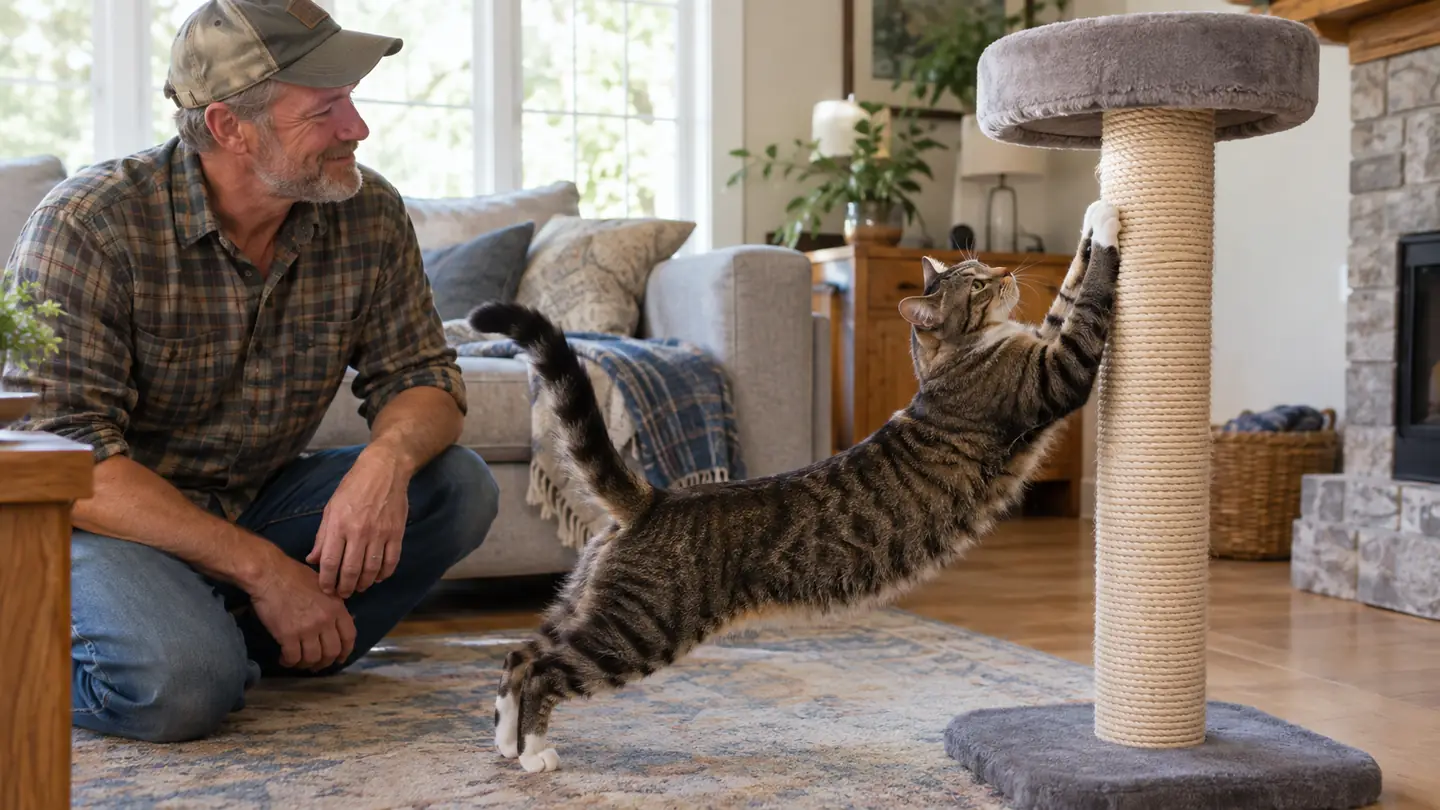
Cats scratch for three reasons: to stretch, to mark territory with the glands in their paws, and to keep claws healthy. A short cardboard pad covers the claw care part, but it does nothing for the stretch. When Pepper stretches against a surface, she wants her whole body extended, front paws high, back arched. The SmartCat post is tall enough that she can do exactly that. The first time she did it, her nose was level with the top of the post.
Height also matters for territory marking. In a multi-pet home, which we are, cats like to leave marks high up, where a rival would have to be big to reach. Pepper is nine pounds. The top of the post is as high as she can reach, and that is where she scratches most. I think it gives her a sense of ownership over the room that she did not have when she was crouching over a cardboard pad.
During my clinic years I saw a lot of declawed cats, and it always broke my heart. Scratching is not a bad habit to break. It is a behavior to steer. A tall post gives a cat the full expression of it, the stretch and the mark, in a place you can live with. That is the whole job, and the SmartCat post does it.
One more benefit I did not expect. The post gives Pepper a morning routine. She wakes up, walks to the post, does her full stretch, and then starts her day. Watching a nine-year-old cat move through that ritual every morning is oddly satisfying, and it tells me the post has become part of her territory, not just a toy she got bored of.
Build Quality: What the Sisal and Base Do Right
The post is one piece, wrapped in heavy natural sisal, with no carpet, no platform, and no dangling toy. That bare design sounds boring, and it is the reason the post works. There is nothing to loosen, nothing to unscrew, nothing for Pepper to rip off. I have owned scratching posts with toys attached. The toys lasted two weeks. The SmartCat post's sisal has lasted six months.
The base deserves its own paragraph. A tall post is only as good as its base, because a cat putting all her weight into a stretch is pulling hard at the bottom. The SmartCat base is wide and heavy enough that the post stays put on carpet and on our hardwood. I have seen it rock maybe an inch when Pepper really throws herself into it. Then it settles back. That is exactly the right behavior.
There is one honest note on the sisal. It is natural rope, so it is a little rough on the hands, and the top section shows wear faster than the middle. That is where Pepper scratches most, and after six months the top third looks fuzzy. The post is still fully usable. If a cat uses one spot constantly, no sisal on earth will stay perfect. The fuzziness is the sign that it is being used, not that it is failing.
Six Months In: What Held Up and What Did Not
Let me give the list of what held up. The base: rock solid. The sisal on the middle and lower sections: like new. The post itself: no wobble, no lean, no loose joints. The whole thing still feels like the day I unboxed it. For something that gets hit several times a day, that is genuinely good.
The messy parts: loose sisal fibers on the floor for the first few weeks, and a fuzzy top section now. Also, the post is tall and plain, so it does not blend into a decorated room the way a fancy cat tree might. It looks like what it is: a sturdy piece of cat furniture. I am fine with that trade. My couch is fine with that trade.
One more thing I noticed. Pepper's claws are noticeably less sharp to the touch. When she kneads my lap, I do not flinch the way I used to. The post is doing the claw maintenance that the cardboard pad used to do, and it does it while giving her the full stretch she never got from cardboard.
One small repair note. Around month four, I noticed a loose thread of sisal near the top where Pepper digs in hardest. I trimmed it with scissors and that was the end of it. No unraveling, no sagging, no need to contact anyone. That has been the whole maintenance budget for six months. I mention it because some posts come apart at the seams under daily use. This one has not.
Six months of daily scratching, and the couch still has just the one mark from the week before the post arrived.
The Tradeoffs: What to Know Before You Buy
I want to be straight about the things that are not perfect. First, the post does not come with a platform. Some cats like to scratch and then sit on top of the thing they just scratched. Pepper does not care. If your cat is a climber who wants a perch, this is not that product. It is a post. That is its whole personality.
Second, the base can slide on very smooth floors if your cat is a hard puller. On our hardwood, Pepper's weight is not enough to move it. But I have read enough owner notes to know that a big, vigorous cat can push it a few inches. The fix is simple: set it against a wall or on a rug. We set ours with one edge against the baseboard, and it has not moved since.
Third, the cost. It costs more up front than a cardboard pad, and I understand the hesitation if you are used to the cheap ones. The way I justified it: I was buying a new cardboard pad every couple of months. The post has outlasted three of them and is still going. Buy it once, or buy it over and over.
One placement tip that made a difference. We started with the post in the corner of the living room, and Pepper used it maybe twice a day. I moved it to the hallway near the bedroom door, right in her main walking path, and her use went up immediately. Cats scratch where they already travel, so put the post where you see the cat most often, not where it looks best.
What We Used Before the SmartCat
Before this post, our scratching setup was a rotation. Cardboard pads on the floor, a carpeted post in the corner, and a little corrugated ramp that Bailey destroyed in a week. Pepper used the cardboard pads, but she used them flat, crouched low, and she never once stretched. The carpeted post she ignored completely. I think the carpet texture reminded her of the couch, and she wanted nothing to do with it.
Here is what the cardboard pads taught me. Pepper liked them well enough, but she went through one every six weeks, and the edges turned into litter on the floor. The cost added up, and the mess did not. The pad also sat low, so it never satisfied the part of her that wanted to reach high. Watching her use the SmartCat post for the first time, with her body stretched to full length, I realized the cardboard had been the wrong shape of outlet all along.
The one alternative I still respect is a good sisal-wrapped cat tree, and we have owned those too. The problem was never the scratching. It was the rest of the tree. Perches loosened, hanging toys vanished, and a wobbly tree is worse than no tree. The SmartCat post strips all of that away. There is nothing to wobble because there is nothing extra. That simplicity is the feature.
What I Liked
- Tall enough for a full-body stretch, which is exactly what cats want
- Wide, heavy base that does not tip and barely moves
- Sisal wrap has held up to six months of daily use with no wobble or loose joints
- Simple one-piece design with nothing to break, unscrew, or rip off
- Pepper stopped scratching the couch within the first week
Where It Falls Short
- Sheds sisal fibers on the floor for the first few weeks
- No platform or perch for cats who like to climb and sit on top
- Plain, utilitarian look that does not blend into a decorated room
- Top section of sisal gets fuzzy with heavy daily use
Who This Is For
This post is for the indoor cat who scratches vertically, the ones who stretch up on the arm of the sofa or the side of the mattress. It is for owners who want one sturdy piece of furniture instead of a rotation of cardboard pads. It is for anyone with a cat like Pepper, a nine-year-old indoor cat with strong opinions, who needs an outlet that is taller than she is. It is also for renters who are tired of replacing a couch they never really owned. If that is your house, this post will very likely end the furniture damage in the first week.
Who Should Skip It
Skip it if your cat is a dedicated horizontal scratcher who has never once stretched up a wall or couch arm. Some cats only scratch flat surfaces, and for them a tall post is a tall waste of floor space. Skip it if you want a multi-level cat tree with perches and hideouts, because this is a single post and it will never be a playground. And skip it if you cannot stand the look of natural sisal, because the post is almost all sisal, top to bottom.
Still standing, still scratching, still saving the couch
Six months in, I would buy the SmartCat post again without thinking twice. If your cat is a vertical scratcher, check today's price on Amazon and read the current owner reviews.
Amazon Check Today's Price on Amazon →